
Scaled
Scaled multiplies an entire penalty, including its existing strengths:
For , its exact proximal map is the inner penalty's map with step . For , it returns zero cost and the identity proximal map, while still validating the inner parameters and dimensions.
Constraint region
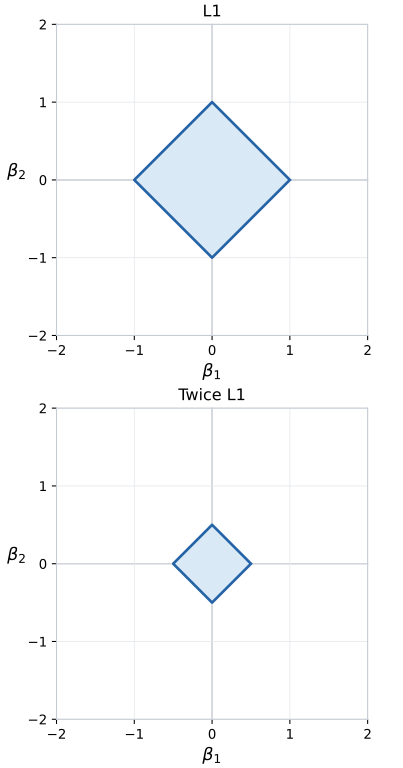
Top: L1::new(1.0). Bottom: Scaled::new(2.0, L1::new(1.0)). At budget one, doubling L1 halves each intercept of its diamond. A zero multiplier makes the entire plane feasible. See the plot conventions.
Use the wrapper
use ;
The multiplier must be finite and nonnegative. Scaling a value-only term does not supply an exact proximal map. A scaled built-in proximal penalty supports proximal gradient, but the wrapper does not add coordinate, IRLS, or hybrid compatibility. Compose it inside AxisPenalty for matrix coefficients.
API: shrinkage::Scaled.