
Group LASSO
Group LASSO selects explicitly defined groups of coefficients together:
Here is the number of groups. Groups must be disjoint, nonempty, and contain valid coefficient indices. DisjointGroups checks these requirements at construction. Supply one finite, nonnegative weight per group. Shrinkage applies those weights directly, without implicit group-size scaling. For a size adjustment, supply weights such as explicitly.
Constraint region
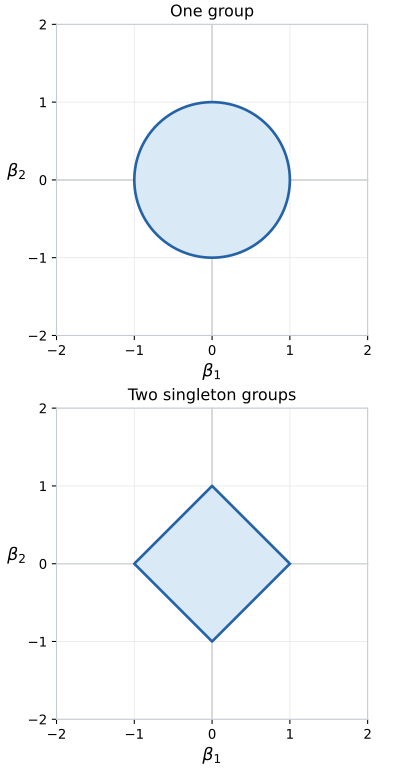
Both panels use and unit weights. One group gives the unsquared L2 constraint . Two singleton groups give . The circle coincides with a ridge sublevel set in this example, although the penalty values and shrinkage differ. See the plot conventions.
Use the penalty
use ;
UncoveredPolicy::Reject requires complete coverage. UncoveredPolicy::Unpenalized leaves uncovered coefficients free. Zero-weight groups are also unpenalized. A group can become exactly zero because the proximal map shrinks its input vector by , with zero input mapped to zero.
Use proximal gradient with Gaussian or binomial datafits. The multivariate model shows how an axis penalty can select features across responses.