Elastic net
Elastic net combines sparse selection with quadratic shrinkage. Its rounded diamond retains corners on the coordinate axes. Supply the two strengths independently with ElasticNet::new(l1, l2). Setting either strength to zero recovers ridge or lasso, respectively.
R(β)=λ1∥β∥1+2λ2∥β∥22. Constraint region
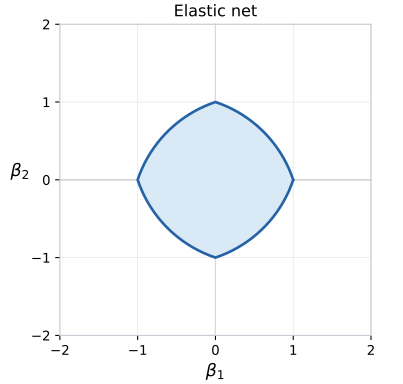
λ1=0.5 and λ2=1: 0.5∥β∥1+0.5∥β∥22≤1. See the plot conventions for the fixed budget and coefficient scale.
Use the penalty
use shrinkage::{ElasticNet, Penalty, ProximalPenalty};

fn main() -> Result<(), Box<dyn std::error::Error>> {
    let penalty = ElasticNet::from_alpha(0.5, 0.7);
    let coefficients = [2.0, -1.0];
    println!("Penalty: {}", penalty.value(&coefficients)?);
    let mut shrunk = [0.0; 2];
    penalty.prox(&coefficients, 1.0, &mut shrunk)?;
    println!("Proximal result: {shrunk:?}");
    Ok(())
}
Alternatively, ElasticNet::from_alpha(lambda, alpha) uses λ1=λα and λ2=λ(1−α), where 0≤α≤1. The proximal map soft-thresholds at sλ1 and then divides by 1+sλ2. Fits support proximal gradient and IRLS.
API: shrinkage::ElasticNet.