
Clustered lasso
Clustered lasso encourages sparse coefficients and equal signed effects. Every unordered pair contributes once. Unlike SLOPE, fusion compares signed values: equal positive and negative magnitudes do not form one fusion cluster. The constructor takes separate L1 and fusion strengths.
Constraint region
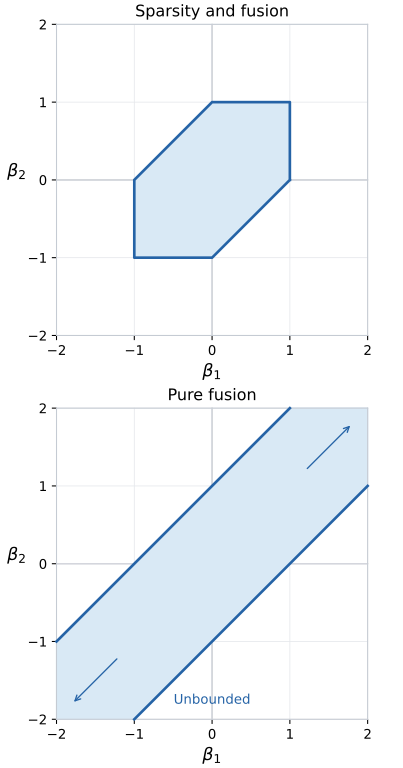
Top: . Bottom: pure fusion, , , giving the unbounded strip . See the plot conventions for the fixed budget and coefficient scale.
Use the penalty
use ;
At zero fusion strength, this reduces to lasso. Without the L1 term, a common shift of all coefficients has no penalty, so the constraint region is unbounded along the equality direction. In two dimensions, its geometry equals that of unit-weight chain fused lasso. With more features, all-pairs and adjacent fusion differ. Gaussian and binomial fits support proximal gradient and hybrid. See the clustered lasso guide for cluster labels and logistic fitting controls.