
L1 (lasso)
The L1 penalty sets individual coefficients exactly to zero. Its diamond-shaped constraint region has corners on the coordinate axes, which favor sparse solutions. At zero strength, the penalty vanishes.
Constraint region
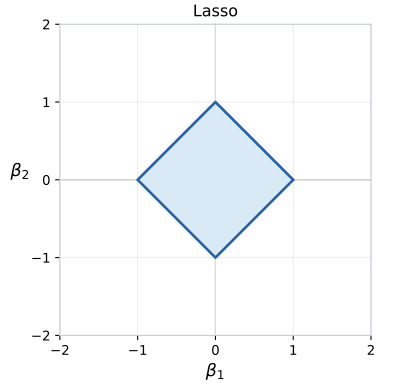
: . See the plot conventions for the fixed budget and coefficient scale.
Use the penalty
use ;
Use coordinate descent for Gaussian lasso, IRLS for Gaussian or binomial datafits, or proximal gradient. The exact proximal map is soft-thresholding at the step size times the strength. The named Lasso model provides the Gaussian convenience API.
API: shrinkage::L1.