
Lasso benchmark
Shrinkage for Python · python · 0.2.0
This comparison shows how quickly the Python APIs of shrinkage, scikit-learn, and skglm reduce the lasso duality gap on one dense problem at one regularization strength.
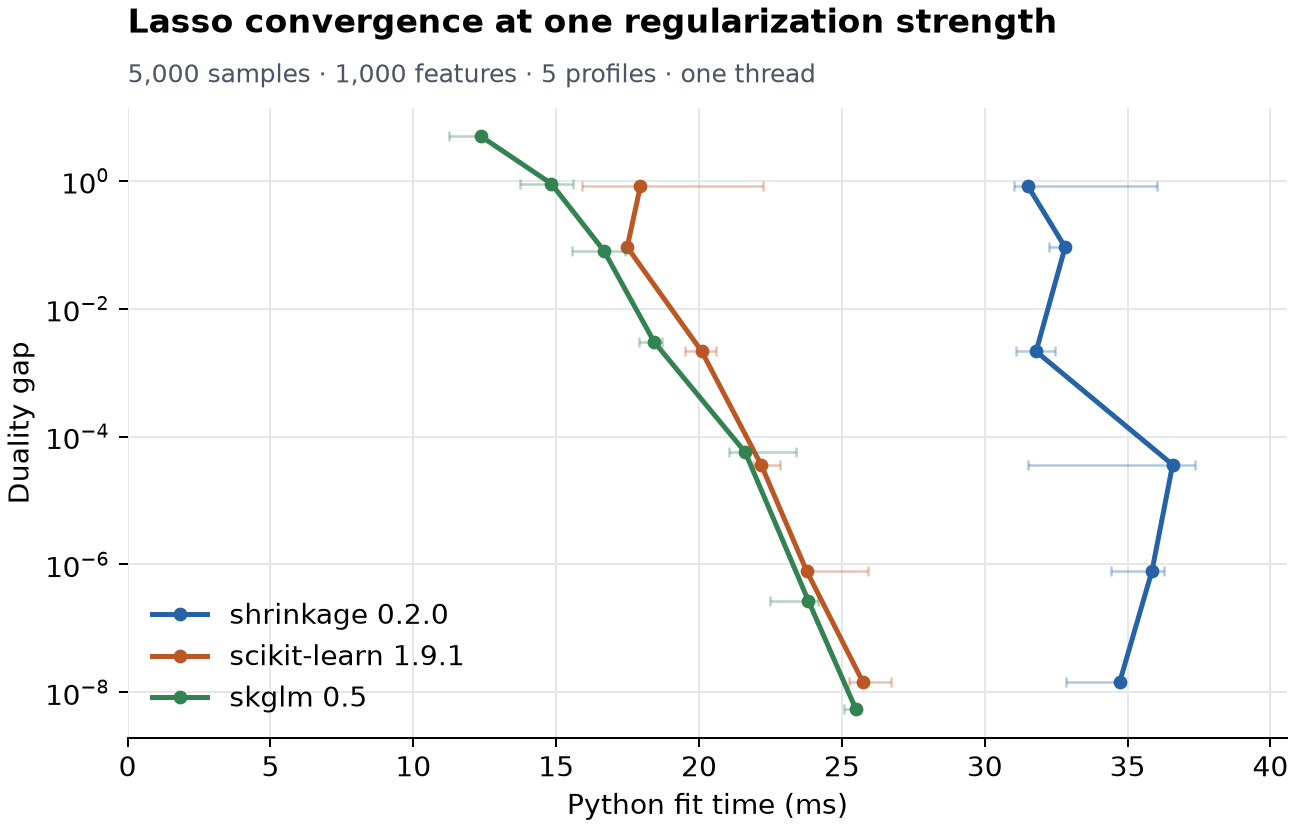
The horizontal axis shows fit time on a linear scale. The vertical axis shows the independently computed duality gap on a logarithmic scale, so convergence over several orders of magnitude remains visible. Each marker shows the median time and gap of five measurements at the same iteration limit. Horizontal error bars span the middle half of the times.
Metewand increases each API's iteration limit from 1 through 40. Shrinkage sweeps its current working set, and scikit-learn sweeps all features. skglm counts working-set subproblems, each allowing up to 50,000 inner coordinate sweeps with Anderson acceleration. Equal limits therefore represent different amounts of work. Every fit starts from zero coefficients. Each curve ends when its independently checked gap meets the accuracy target. Each point's time measures that fit from initialization through its selected limit.
The figure uses Metewand's in-worker timer around model construction and the call to fit. This includes input validation, the copies required by each API, and numerical fitting. Loading the dataset, importing packages, extracting coefficients, serializing results, and checking accuracy happen outside that timer.
Problem and accuracy
The dataset has 5,000 observations and 1,000 independent standard Gaussian features. The response uses 20 nonzero coefficients, alternating between 1 and −1, plus standard Gaussian noise. The manifest fixes NumPy's dataset seed at 7363749798296254, preserving the original dataset derived from experiment seed 42. This keeps the arrays stable when the benchmark runner or software changes. We center the features and response once before fitting and pass all three methods the same Fortran-contiguous NumPy float64 arrays.
All three methods minimize
The plotted gap is the primal objective minus a feasible dual objective. It provides an upper bound on the objective's suboptimality at the returned coefficients.
We disable intercept fitting and shrinkage's default column standardization. scikit-learn uses cyclic coordinate descent without a precomputed Gram matrix. Shrinkage and scikit-learn copy their inputs; skglm can reuse the supplied arrays. skglm uses its Lasso API with the default initial working-set size of 10 and subdifferential-based working-set selection.
The common target is a duality gap no larger than 1e-8 times the null-model loss ||y||² / (2n). shrinkage uses StoppingCriterion.duality_gap(relative=1e-8). scikit-learn uses tol=5e-9 because its gap threshold scales with ||y||² / n; it also checks coordinate updates. skglm uses tol=1e-10 for its maximum subdifferential violation, which differs from a duality-gap threshold. The common evaluator determines when its curve ends. See the skglm Lasso documentation for its objective and iteration controls.
An independent NumPy evaluator recomputes the objective, a feasible dual bound, and the KKT violation from the returned coefficients. Every plotted curve must end at the common gap target. Earlier points retain their larger gaps. See scikit-learn's Lasso documentation for its objective and stopping rules.
Measurement and reproduction
Shrinkage checks full convergence at initialization, every ten coordinate sweeps, and at the iteration limit. Working sets update at these checks. The initial budget uses the number of initial KKT violations, bounded between 10 and 64 features. The profile allows up to 40 sweeps to accommodate this cadence.
On Linux, shrinkage copies matrices of at least 4 MiB into anonymous Rust-owned mappings with transparent huge-page advice. Smaller inputs, other platforms, and unsuccessful mapping or advice requests use ordinary Rust allocations. Both paths preserve the same input-copy and ownership contract. NumPy also uses huge-page advice on Linux.
The run uses a release build of shrinkage with one code-generation unit, one thread per numerical library, serial execution, one discarded warm-up per worker, and five measured profiles per implementation. Metewand's fresh_sequence profile supports these fits at increasing iteration limits without adding callbacks to the solvers. It randomizes method order within comparison blocks. Workers retain their imports, but every fit creates a new model. skglm's Numba compilation occurs during the discarded warm-up, so the figure describes fits with compiled kernels. A single compute bench reservation covers all three methods.
The retained measurements are Metewand's JSON analysis export. They contain complete observation metrics, effective settings, profile progress, and recorded provenance. Shared provenance identifies the CPU, operating system, source revision and dirty status, Metewand executable hash, dataset seed, and dataset content hash. Worker statistics identify Python and numerical package versions and the native-extension hash. The export also retains Metewand's primary execute_only wall time, which includes result conversion and protocol work.
Metewand checks declared repetitions and profile completion before exporting. The figure uses selected successful measurements, including valid intermediate points with larger gaps. A successful retry can supply those measurements after an earlier failure. The full run directory retains the attempt history.
From the repository root, with the Metewand CLI installed:
The benchmark sources and setup instructions explain CLI installation and figure regeneration. Documentation builds use the saved figure and do not execute the benchmark.
These timings describe one simulated dataset on one machine. Other matrix sizes, feature correlations, regularization strengths, and real datasets may change the comparison. This benchmark does not measure regularization paths, sparse inputs, cross-validation, or memory use.